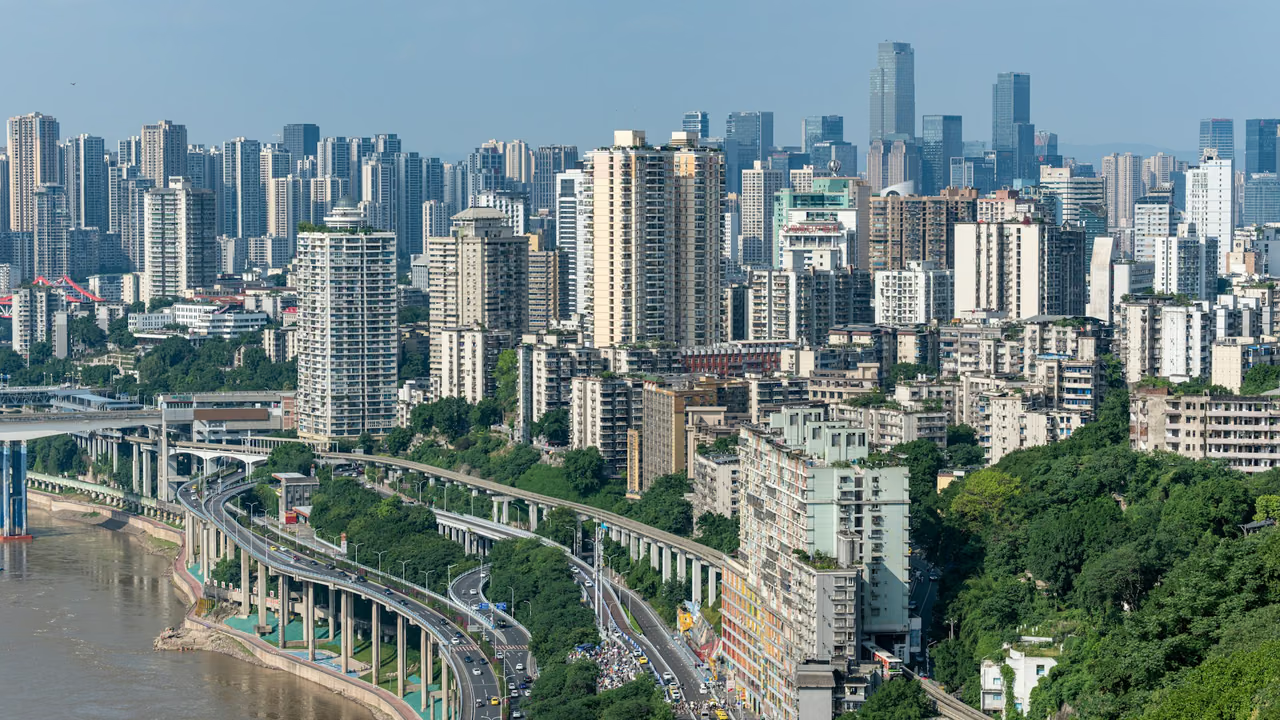
This three-day itinerary balances Chongqing's essential sights with easy travel routes. Explore central Yuzhong and Hongya Cave on day one, head to Liziba and Ciqikou on day two, and spend day three discovering regional history and south-bank skyline views.
Getting ready for day one
Staying in central Yuzhong District (渝中区) near Jiefangbei or Xiaoshizi keeps your trip simple. Most morning starts will be an easy walk or a direct metro ride away. Chongqing is built across steep hills with roads stacked on multiple levels, so walking routes often involve outdoor steps rather than flat sidewalks.
Set up mobile payments like Alipay or WeChat Pay before heading out. Save the Chinese names and addresses of your stops to show taxi drivers or enter into map apps. Take the metro between distant districts, and use official taxis or ride-hailing cars for steep hillside connections. Use the city map to locate the stops and group nearby visits.
Day one: Jiefangbei, Shibati, and Hongya Cave lights
Start your morning at the Jiefangbei Clock Tower (解放碑), the central monument in the main pedestrian shopping district. It makes a clear orientation point and meeting spot. Grab breakfast nearby with a bowl of spicy Chongqing noodles (重庆小面). Check our everyday eating guide for tips on ordering breakfast without heavy chili oil, and browse the local shopping guide for everyday essentials.
After lunch, walk south to (十八梯). This hillside neighborhood features restored traditional buildings, staircases, and tea shops sitting directly below modern skyscrapers. Take your time exploring the lanes, then head back to your hotel to rest before dusk.
Eat an early dinner, then walk to Hongya Cave (洪崖洞). Enter from the upper city level on Cangbai Road (沧白路). To see the glowing multistory wooden stilt houses from below, take the internal elevators or public stairways down to Jiabin Road (嘉滨路). For a wide panoramic photo of the lit facade, walk onto the pedestrian deck of Qiansimen Bridge (千厮门大桥).
Day two: Liziba monorail, Ciqikou, and evening hotpot
Take Metro Line 2 in the morning to Liziba Station (李子坝). Ride the train into the station structure built into a residential building, then head down to the street-level viewing platform along the river to watch trains pass overhead. Spend 30 to 45 minutes here for photos. Check station signage for current pedestrian paths while platform facility upgrades continue. Read our Liziba guide for route details.
Next, take Line 2 to Daping (大坪), then change to Line 1 for Ciqikou Station (磁器口). Walk from the station to Ciqikou Ancient Town (磁器口古镇). Ciqikou developed as a busy river trading port on the Jialing River. Spend the afternoon wandering through stone-paved lanes, visiting teahouses, and tasting snacks like mahua twisted dough fritters. Our Ciqikou guide highlights quieter side alleys away from the main commercial street.
Return to central Yuzhong for a traditional Chongqing hotpot (重庆火锅) dinner. If anyone in your group prefers mild food, order a split pot (鸳鸯锅) with clear bone or mushroom broth on one side and spicy beef tallow broth on the other. Use our hotpot guide for a step-by-step ordering walkthrough.
Day three: Three Gorges Museum and Nanbin Road skyline


Spend your morning at the China Three Gorges Museum (重庆中国三峡博物馆). The exhibits trace the history of the Yangtze River gorges, ancient Ba-Shu culture, and Chongqing's wartime role. Across the public plaza sits the Great Hall of the People (人民大礼堂), which is great for an exterior photo. The Three Gorges Museum offers free entry with your original passport and does not require advance booking. It is closed on Mondays except on public holidays. See our museums and history guide for highlight galleries.
After lunch, take the metro to Xiaoshizi (小什字), then ride Line 6 across the Yangtze to (上新街). Walk towards Longmenhao in Nan'an District on the south bank. Explore Longmenhao (龙门浩) and the neighboring (下浩里) old streets. These hillside communities combine heritage brick architecture, cliffside cafes, and peaceful vantage points looking back at the Yuzhong peninsula.
Take a taxi to a named upper entrance to shorten the uphill walk. With a stroller or less energy, explore one part of the neighborhood and stop at a cafe. Choose your return pickup point before walking downhill.
Finish your evening along Nanbin Road (南滨路) with dinner at a riverside restaurant and an evening walk along the river promenade to enjoy the illuminated Yuzhong skyline. You can also book an evening river cruise from Chaotianmen Pier to see the city lights from the water.
Two full days: choose what to leave out
For a first visit focused on the best-known city sights, follow Day one and Day two above. You keep the river lights, hillside lanes, monorail, Ciqikou and hotpot. Leave the museum and south bank for another visit, rather than adding them between distant stops.
If history and old neighborhoods matter more to you, follow Day one and Day three instead. You trade Liziba and Ciqikou for museum galleries and the restored south-bank streets. Have hotpot after the museum or near your hotel; the meal does not need a separate sightseeing day.
These plans need two full days. An arrival afternoon gives you the first evening's lights, but less time for daytime walks.
A slower culture day: replace Day two
Choose this route instead of Liziba and Ciqikou if you prefer carved buildings, river-port history and a longer tea break. Keep Day three for the museum and south bank; this walk stays in eastern Yuzhong.
Take a taxi to People's Park (人民公园) on Gongyuan Road (公园路). Start on the higher city streets and walk downhill towards Baixiang Street (白象街). The old trading street gives context to the river port, with former guild buildings among today's shops.
Continue east along public streets to Huguang Guild Hall (湖广会馆). Allow 60 to 90 minutes inside to see the courtyards and carved wooden opera stages. Budget around CNY 32 (≈ USD 4.8 ≈ USD 4.8) per adult for admission. The halls tell the story of migrants who formed trading and support communities in Chongqing. Finish beside Dongshuimen (东水门), the preserved stone city gate next to the complex.
Allow 3 to 4 hours for the route, including the guild hall visit and a tea break. It leaves time for lunch and a relaxed afternoon instead of a trip across the city. Our old streets and teahouses guide gives the full walk and separate tea outings. Use the Huguang Guild Hall map point to find the lower riverside area.
Adding a fourth or fifth day
With four full sightseeing days, keep these three city days and add one outing. Choose Wulong for limestone arches and canyon scenery. Choose Dazu Rock Carvings for Buddhist stone art and scenes of historical daily life. Each needs its own day for the journey and visit.
A fifth full day lets you visit the other site, or take the slower culture walk above if you kept Liziba and Ciqikou. The four and five day itinerary also covers arrival and departure days, hotel nights, and an overnight stay in Wulong. Use that plan when your four or five calendar days include flights, rather than counting them all as full sightseeing days.
Adjusting the schedule
If it rains, spend extra time inside the Three Gorges Museum or Ciqikou's covered teahouses. In hot summer months, do outdoor walks around Shibati and Liziba in the early morning, take a long indoor break in the afternoon, and resume sightseeing after sunset.
Move Day three to another day if it falls on a Monday museum closure.
Common questions
Can I include a Wulong day trip in a three-day visit?
Yes. Replace Day three with a full day in Wulong, which leaves out the museum and south bank. High-speed rail connects Chongqing East and Wulong South, followed by local transfers to the scenic area. Use the Wulong day-trip guide to plan the train and mountain transfers.
Should I choose the Yangtze River Cableway or a river cruise?
The Yangtze River Cableway provides a quick 5-minute aerial ride between Yuzhong and Nan'an with classic high-angle views. A river sightseeing cruise lasts 45 to 60 minutes, giving you a seated view of the illuminated waterfront and bridges.
How should I adapt this route if I arrive in the afternoon?
Check into your hotel, grab dinner near Jiefangbei, and spend the evening enjoying Hongya Cave and Qiansimen Bridge. Shift the Shibati walking tour to any open afternoon window during the remaining days.
Sources & updates
- Liziba, More than a Subway Station: iChongqingLast updated Oct 4, 2026
- Chongqing museums: iChongqingLast updated Oct 4, 2026
- Ciqikou history: iChongqingLast updated Oct 4, 2026
- Hongyadong: iChongqingLast updated Oct 4, 2026
- Museum entry without advance booking: official museum noticeLast updated Oct 4, 2026
- Longmenhao and Xiahaoli urban renewal: iChongqingLast updated Oct 4, 2026
- Chongqing Rail Transit via city government: 2026 Liziba station worksLast updated Oct 4, 2026
- Chongqing municipal government: interchange adviceLast updated Oct 6, 2026
- Chongqing municipal government: rail operator replies, 20 May 2026Last updated Oct 6, 2026
- iChongqing: Huguang Guild HallLast updated Oct 6, 2026
- iChongqing: Chongqing Huguang Guild HallLast updated Oct 6, 2026
- Chongqing municipal English portal: museum overview, 13 June 2026Last updated Oct 6, 2026
- Yangtze Cableway operator: Xiaoshizi and Shangxinjie metro approachesLast updated Oct 6, 2026
Did this guide help you?
Why? (optional)


