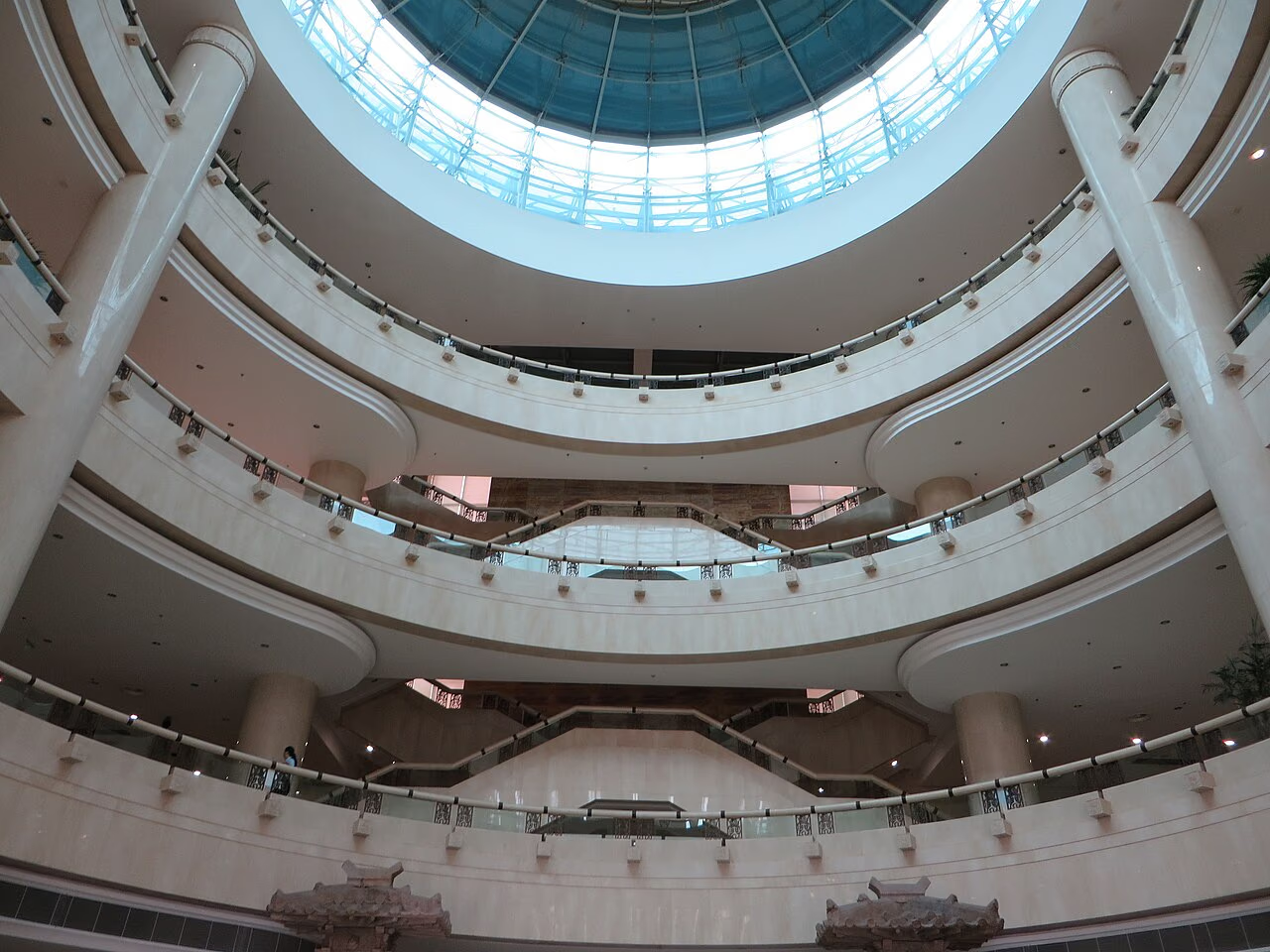
Start with the Three Gorges Museum for river history. Visit Huguang Guild Hall for migrant stories and wooden opera stages, or head to Liziba for World War II exhibits.
Start with the Three Gorges Museum
The Chongqing China Three Gorges Museum (重庆中国三峡博物馆) stands at 236 Renmin Road (人民路) beside People's Square (人民广场). Its four floors cover river history, ancient art and the city's growth.
Start in the Three Gorges galleries to explore life along the Yangtze River (长江). You will find ancient boat relics, river trade tools and items saved before the Three Gorges Dam raised water levels. If you plan to take a Yangtze cruise, these rooms explain the canyon geology and boat legends.
Higher floors show ancient Bayu bronze culture, wartime capital history and modern urban changes. Plan for about two hours and pick two or three galleries that match your interests.

The Great Hall across the square

Directly across the plaza stands the Great Hall of the People (重庆市人民大礼堂). Builders completed this auditorium between 1951 and 1954, topping it with a green-tiled dome inspired by Beijing's Temple of Heaven.
The open plaza of People's Square gives you the clearest view for photos. You can capture the red pillars and curved roof against the hillside, and take 15 to 20 minutes to watch local kite flyers and dance groups on the paved square.
Huguang Guild Hall for courtyards and migration

Huguang Guild Hall (湖广会馆) sits beside the Yangtze near Dongshuimen Bridge. Bright yellow walls enclose stepped courtyards, quiet meeting halls and carved wooden opera stages. Plan for 60 to 90 minutes. You can buy an online admission ticket for about CNY 40 (≈ USD 6.0 ≈ USD 6.0) per person.
Start in the migration museum. War and famine reduced Sichuan's population in the late Ming and early Qing dynasties. The Qing government encouraged families from Hunan, Hubei, Guangdong and other provinces to settle here. Guild halls gave these new arrivals a community network and a place to meet people from home.
To follow this story, visit Yuwang Palace (禹王宫) next. Its shrine honours Yu the Great, the legendary ruler who tamed early floods. Walk into Guangdong Hall (广东公所) to see the large stage's octagonal ceiling and carved dragons. Finish at Qi'an Hall (齐安公所), where stage carvings show riverside boats and southern home towns.
From People's Square, take a taxi or ride-hailing car to the guild hall rather than walking across the steep peninsula ridges.
Dongshuimen and a slow old-city walk
Outside the guild hall, look for the stone arch of Dongshuimen (东水门) beneath the bridge approach. This Ming-dynasty gate linked the walled city with its busy river docks.
For more street scenes, continue toward Baixiang Street (白象街) with our old streets and teahouses guide. For Buddhist stone carvings, head to Luohan Temple (罗汉寺) near Xiaoshizi station. If you want to see both, start at Luohan Temple and walk downhill toward Dongshuimen and the guild hall.
World War II and the Flying Tigers
Chongqing served as China's wartime capital during World War II. Two nearby museums focus on this period of international cooperation:
- The General Joseph W. Stilwell Museum (史迪威博物馆)
- The Chongqing Flying Tigers Museum (重庆飞虎队展览馆)
The Flying Tigers Museum sits on Jialing New Road (嘉陵新路) in Liziba (李子坝). You can pair it with watching the train that runs through a residential building at Liziba. Set aside about an hour to view flight jackets, vintage photographs and diaries from volunteer pilots.
Practical tips: hours, tickets and transport
- Admission and passport rules: Permanent exhibits at the Three Gorges Museum are free. You do not need to book online in advance; show your original passport at the entrance security gate. Huguang Guild Hall requires a paid ticket.
- Opening hours: The Three Gorges Museum opens Tuesday to Sunday from 09:00 to 17:00, with last entry at 16:00. It closes on Mondays, except on official Chinese public holidays.
- Rainy days: Air-conditioned galleries make the Three Gorges Museum a reliable indoor rainy day option. A translation app with camera mode helps with artifact label details.
- Getting around: Yuzhong District has long outdoor staircases and steep grades. Taxis and ride-hailing cars drop you directly at museum doorways, saving your legs for walking through the halls.
Dates and experiences for your trip
See all current eventsCrafts and living traditions at Chongqing Art Museum
Oct 13 – Nov 15, 2026
Free entry
Look closely at detailed embroidery, lacquer work, and handmade ceramics. It makes a calm indoor stop right by Jiefangbei, fitting smoothly between lunch and your evening plans.
Longgupo archaeology at Three Gorges Museum
Oct 13, 2026 – Jan 3, 2027
Free entry
See fossils and stone artefacts in 龙骨坡的故事:“巫山人”考古探秘, then continue through the museum’s regular galleries. This free exhibition makes an indoor stop for visitors interested in archaeology.
Mountains and rivers at Three Gorges Museum
Oct 13, 2026 – Jan 17, 2027
Free entry
Old paintings, historical items, and vintage photographs show the story of the river landscape. Combine this special gallery with the main museum halls for a quiet rainy-day visit.
Chongqing Art Museum collection exhibition
Oct 13 – Dec 31, 2026
Free entry
This quiet gallery visit fits neatly into an afternoon around Jiefangbei. Enjoy the artworks at your own pace, then head out for street snacks on Bayi Road or a walk by the river.
Sources & updates
- Three Gorges Museum: reservation removal notice, 30 September 2025Last updated Oct 4, 2026
- Three Gorges Museum: official admission and opening hoursLast updated Oct 4, 2026
- Chongqing municipal government: Three Gorges Museum overview, June 2026Last updated Oct 4, 2026
- iChongqing: Great Hall of the PeopleLast updated Oct 4, 2026
- iChongqing: Huguang Guild HallLast updated Oct 4, 2026
- iChongqing: Chongqing American Volunteer Group MuseumLast updated Oct 4, 2026
- iChongqing: Stilwell Museum and shared wartime historyLast updated Oct 4, 2026
- Chongqing Municipal Government: museum visitor guide, July 2026Last updated Oct 4, 2026
- Chongqing Archives: Huguang Guild HallLast updated Oct 6, 2026
- Chongqing Local Chronicles: Huguang Guild HallLast updated Oct 6, 2026
- iChongqing Cultural Relics in Yuzhong DistrictLast updated Oct 6, 2026
- Chongqing municipal government: Three Gorges Museum visitor information, August 2026Last updated Oct 6, 2026
Did this guide help you?
Why? (optional)